FastAPI Is Eating Flask’s Lunch and Django Should Pay Attention
Python’s web ecosystem has always moved fast, but lately it feels like one framework is quietly turning “best practices” into defaults. FastAPI takes the things developers already reach for—type hints, async/await, and Pydantic models—and then does something Flask and Django users often have to cobble together: it turns that structure into request validation, predictable serialization, and excellent documentation automatically. If you’re building APIs in 2024, you’re either choosing FastAPI because it fits, or you’re choosing something else for reasons that must be painfully specific.
The real shift: type hints stop being decoration⌗
Flask is flexible, which is another way of saying it leaves responsibility on the developer. You can validate input, generate schemas, document endpoints, and serialize responses—but you build that stack yourself. Django can be even more “batteries included,” but its API story tends to be oriented around forms, models, templates, and server-rendered workflows—then adapted for APIs.
FastAPI flips the philosophy: it treats type hints as part of the application contract. Instead of “Here’s a function that receives JSON,” the code says “Here’s a function that receives a specific model, and here’s what it returns.” That contract is then used for three practical outcomes:
- Automatic request validation
- Automatic response serialization
- Automatic API documentation
Consider an endpoint that creates a “user” resource. With FastAPI, you define a request model and a response model, and the framework enforces and documents them without extra glue code.
from fastapi import FastAPI
from pydantic import BaseModel
from uuid import UUID, uuid4

app = FastAPI()

class UserIn(BaseModel):
    email: str
    age: int

class UserOut(BaseModel):
    id: UUID
    email: str
    age: int

fake_db = {}

@app.post("/users", response_model=UserOut)
def create_user(payload: UserIn) -> UserOut:
    user_id = uuid4()
    user = UserOut(id=user_id, email=payload.email, age=payload.age)
    fake_db[str(user_id)] = user
    return user
You’re not writing “validation logic.” You’re writing data shapes, and FastAPI does the rest. If a client sends "age": "thirty", it fails fast with a structured error. That’s the difference between a framework that assists and a framework that enforces.
Automatic docs aren’t a luxury—they’re leverage⌗
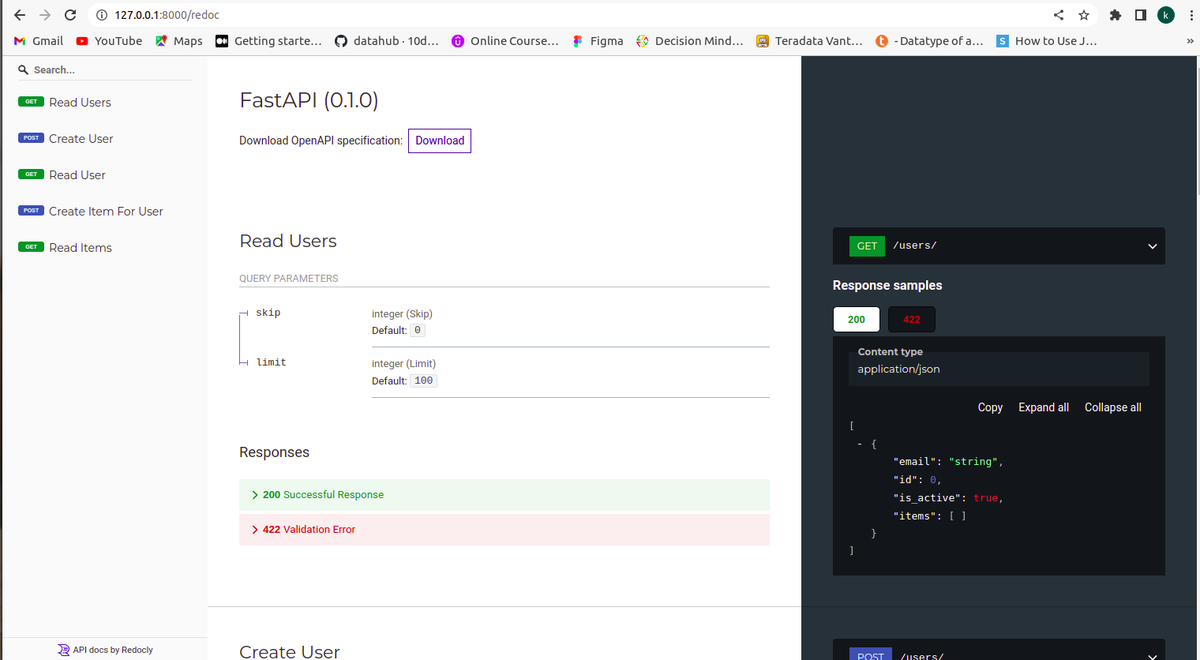
Swagger UI and OpenAPI documentation are often treated as a checkbox. FastAPI makes them a byproduct of doing real modeling work.
When you define endpoints with typed inputs and response_model, FastAPI can generate an OpenAPI schema and interactive docs automatically. That matters because documentation becomes part of the workflow, not a follow-up chore. Your API stops being “something in a README” and becomes something clients can explore and test immediately.
Try this mindset shift: imagine your team shipping an API to another team that needs examples, field meanings, and error formats. With Flask, you either maintain docs manually or integrate a documentation library. With Django, you often rely on Django REST Framework tooling and serializers—useful, but heavier. With FastAPI, the contract you already coded becomes the contract the docs show.
Even better: the docs tend to stay accurate because the source of truth is the Python typing and the Pydantic models. That’s how you reduce the classic “docs drift” problem: you don’t need discipline so much as you need the framework to make correctness the path of least resistance.
Validation that reduces back-and-forth (and incidents)⌗
Most API failures aren’t dramatic—they’re mundane. A client sends the wrong field name. A number arrives as a string. A nested object is missing. Suddenly you’re parsing errors from logs, guessing what the caller meant, and rebuilding a tiny spec in a Slack thread.
FastAPI’s validation pipeline is one of its most practical advantages. Because Pydantic models define constraints and types, FastAPI can:
- reject invalid requests before they hit your business logic
- produce consistent error responses
- keep serialization predictable
You can also express constraints directly in the model. For example, if an email must be non-empty and age must be within a range, say so in code and let the framework enforce it.
from pydantic import BaseModel, Field

class UserIn(BaseModel):
    email: str = Field(min_length=3)
    age: int = Field(ge=0, le=120)
Now your API becomes harder to misuse. That’s not “developer experience” in a fluffy sense; it’s fewer broken requests reaching production. It’s less time spent writing guardrails, because you’ve already encoded them.
Async in the places that matter⌗
FastAPI also benefits from async/await being a first-class citizen rather than an afterthought. Async is most valuable when your API spends time waiting: database calls, HTTP requests to other services, file I/O, and streaming responses.
Flask can work with async-like patterns, but it historically hasn’t made the async model feel native. Django can do async views, but using Django for high-throughput API services often feels like dragging a feature-rich environment into a job it wasn’t primarily designed for.
In FastAPI, async endpoints feel straightforward:
from fastapi import FastAPI
import httpx

app = FastAPI()

@app.get("/weather")
async def get_weather(city: str):
    async with httpx.AsyncClient() as client:
        resp = await client.get(f"https://example.com/weather?city={city}")
        data = resp.json()
        return {"city": city, "forecast": data}
This isn’t about chasing “async hype.” It’s about having a framework that doesn’t fight you when you need I/O concurrency. If your API integrates with other services (which most do), async can improve responsiveness and reduce resource burn.
Flask feels primitive—because you’re rebuilding infrastructure⌗
Flask isn’t a bad framework. It’s lightweight. But lightweight cuts both ways: when your application grows into an API platform, you end up stitching together:
- request parsing and validation
- serialization
- error handling patterns
- OpenAPI schema generation
- dependency injection for common concerns (auth, database sessions, etc.)
FastAPI collapses much of that into the framework itself. The result is not just faster development—it’s fewer mismatched conventions across endpoints.
A practical example: authentication and dependency injection.
With FastAPI, you typically model authentication as a dependency and reuse it across endpoints. That encourages consistency: every endpoint that needs auth declares it clearly in the function signature, and the framework calls the dependency appropriately.
You can keep Flask for simple services, internal tools, or projects where the API surface is tiny and unlikely to grow. But if you’re building a serious API product—one that needs validation, documentation, and predictable contracts—FastAPI’s approach tends to win because it keeps the complexity where it belongs: in the framework, not in your codebase.
Django shouldn’t ignore APIs anymore⌗
Django’s “batteries included” identity is real. But that strength can become friction for API teams who want speed, clean typing, and automatic schema-driven behavior. Django’s API ecosystem (often through Django REST Framework) is capable, but it can feel heavy when you’re trying to move quickly and keep interfaces explicit.
Here’s the honest trade: Django is an excellent general-purpose web platform. FastAPI is a surgical tool for API development. When you combine typing-driven contracts with automatic validation and docs, you get a development loop that’s hard to beat—especially when your team cares about correctness and client integration.
Django can—and should—learn from that philosophy. Even if you keep Django for the core site, FastAPI is increasingly the “API front door” in modern architectures. Common patterns include:
- Django for admin and core business workflows
- FastAPI for high-velocity external API endpoints
- Shared domain logic where it makes sense, without forcing one framework to become the other
If you’re a Django shop, this doesn’t mean abandoning Django. It means acknowledging that an API-centric workflow is now a first-class requirement, and FastAPI is delivering it with less friction.
Conclusion: choose the framework that turns contracts into behavior⌗
FastAPI isn’t “winning” because it’s trendy. It’s winning because it treats the API contract as executable code—using type hints and Pydantic models to generate validation, serialization, and documentation. Flask’s flexibility and Django’s batteries are both valuable, but if you’re building new APIs in 2024, you should ask a blunt question: do you want to build the plumbing yourself, or do you want your code’s structure to drive correctness?
If your answer is the latter, FastAPI is the default choice. And if you’re still investing in Flask or Django for API work, make sure you can justify the extra effort—because clients increasingly prefer APIs that are self-describing, strictly validated, and effortless to integrate.