Hono Became the Express.js of the Edge Computing Era
Edge computing used to feel like a niche hobby—deploy a toy API to a single platform and pray your code survives the next runtime update. Hono changes that vibe. It’s the rare web framework that feels purpose-built for today’s reality: many runtimes, many deployment targets, and too much time wasted on “it works on Workers but not on Lambda.”
Hono has crossed 50,000 GitHub stars for a reason. It’s small, standards-forward, runtime-agnostic, and surprisingly pleasant to use. If Express defined the Node.js web era, Hono is shaping what comes next: runtime-independent, edge-first services that you can ship without rewriting everything every time your infrastructure changes.
What Makes Hono Feel Like “Express, but for Everything”⌗
Express became the default because it hit a sweet spot: simple routing, middleware that’s easy to reason about, and an ecosystem that kept growing. Hono hits a similar sweet spot—but with a crucial upgrade: it runs on every JavaScript runtime you care about.
The headline is the size: Hono is roughly 14KB. That matters more than it sounds. Smaller frameworks mean fewer abstraction leaks, faster cold-starts in serverless environments, and less overhead when you’re pushing requests through an edge runtime where every millisecond counts.
But the bigger reason Hono feels familiar is how it models the web. Hono follows standards-based request/response patterns instead of forcing you into a platform-specific API. In practice, that means your handlers look like web code—not like a runtime-specific experiment.
Concretely, you can write the same application using the same core APIs across Node.js, Bun, Deno, Cloudflare Workers, and AWS Lambda-style environments—without “runtime branches” scattered throughout your codebase.
Standards-Based by Default: Write Web Code, Not Runtime Code⌗
The easiest way to understand Hono is to treat it like you’re writing for the web first. You’re working with the semantics you already know: HTTP requests, headers, bodies, status codes, and responses.
This matters when you move to the edge because edge runtimes don’t share the same assumptions as traditional Node.js servers. Some don’t support the Node.js standard library the way you expect. Some don’t behave like a long-running process. Some have different streaming and body-handling behavior.
Hono avoids the worst of that by aligning with the web platform’s primitives. The result is that migrating from “local Node server” to “edge deployment” is far less about porting and far more about packaging and configuration—exactly what you want.
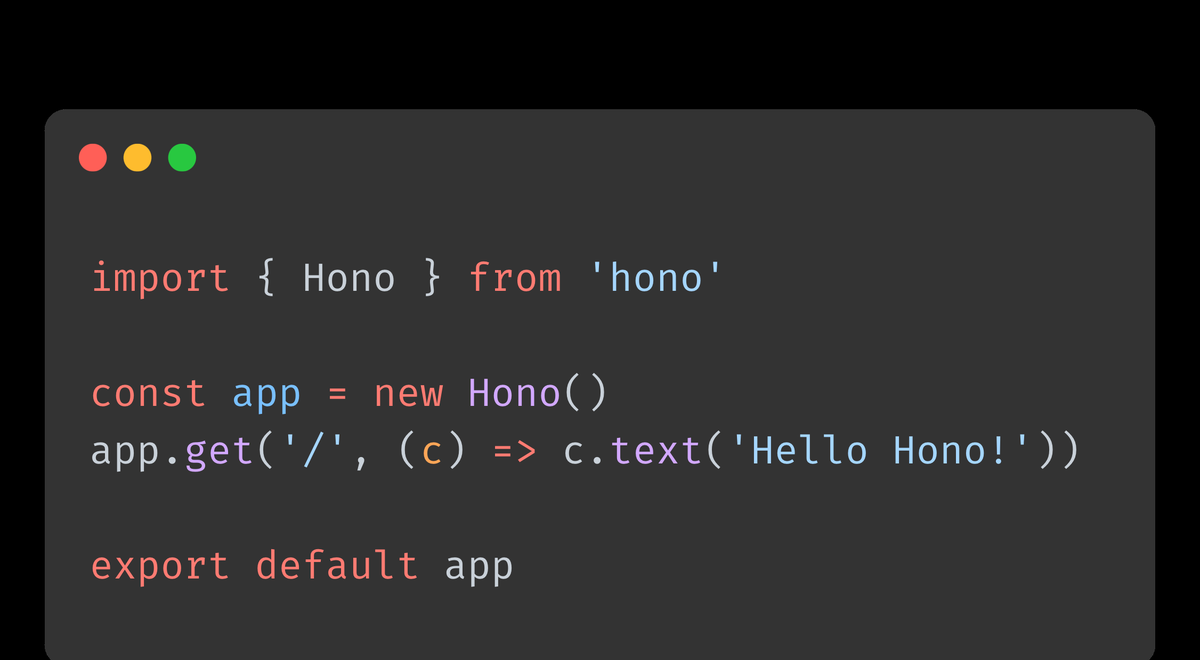
Practical example: a minimal route that stays portable⌗
With Hono, you can keep your app logic focused on request handling rather than on the runtime’s quirks. A route stays a route whether you deploy it to a worker or a serverless function. The interface is familiar, but the portability is the point.
You won’t need to learn a separate framework dialect for each platform—because Hono isn’t pretending the platforms are the same. It’s building a stable layer on top of their shared web capabilities.
TypeScript You’ll Actually Enjoy (Plus an RPC Helper)⌗
Most “frameworks with TypeScript support” still feel like TypeScript-as-afterthought. Hono doesn’t. TypeScript integration is one of the places where it feels modern and confident, not bolted on.
You get solid inference and ergonomic patterns that help you keep types accurate as your handlers grow. But the real differentiator for teams building real services is the RPC helper—an approach that supports end-to-end type safety.
That’s not just a developer-experience win; it’s an operational win. When client and server disagree about shapes—payload fields, return types, or error formats—you usually find out in production. With an RPC-style workflow, you can catch those mismatches at development time.
What “end-to-end type safety” means in practice⌗
Imagine you have a createUser operation:
- Your API expects
{ email: string; name: string } - Your frontend supplies those fields
- Your code transforms them into a database-ready model
- Your API returns a structured response your UI uses to render the next state
With a type-safe RPC helper, you’re not maintaining two separate contracts in two separate places. You’re maintaining one. That reduces churn and makes refactors dramatically less scary—especially when you’re shipping quickly across environments.
Middleware and Ecosystem: Mature Enough to Build Real Products⌗
A framework is only as good as its “boring parts”—logging, auth, validation, compression, error handling, and the rest of the daily glue code that turns routes into a product.
Hono’s middleware ecosystem is mature enough that you can assemble common patterns without reinventing everything. That’s crucial if you want to migrate from Express without feeling like you’re starting from scratch.
You can take your existing Express mental model and map it over:
- Middleware chains become middleware chains
- Route handlers remain handlers
- Composition stays straightforward
The migration story here is the opposite of the painful kind. You shouldn’t be rewriting your business logic. You should be swapping the framework layer, adjusting a few API details, and shipping.
Migrating from Express: The Sharp, Practical Path⌗
Let’s be honest: most teams don’t “rewrite” when they adopt a new framework. They migrate.
The good news is that migrating from Express to Hono is typically straightforward because your architecture already exists:
- Routes and controllers: Move handler functions over with minimal logic changes.
- Middleware: Convert middleware registration to Hono’s approach.
- Request/response details: Adjust anything that relied on Node-specific behavior.
- Validation and serialization: Prefer Hono-friendly patterns so your code stays runtime-agnostic.
- Deploy target: Pick the edge runtime you want first—then make sure the app behaves the same everywhere.
A realistic example: turning an Express-style API into Hono⌗
Say your Express app has:
/healthroute- authentication middleware
- a couple of JSON endpoints
- centralized error handling
In Hono, the structure remains familiar: you define routes, attach middleware, and keep your logic in handler functions. The biggest differences tend to show up only where Express code relied on Node’s streaming quirks, request object extensions, or nonstandard response helpers.
The payoff is immediate: once deployed, edge runtimes typically feel snappier. Your service stops “waiting” on the same server characteristics every time and benefits from closer geographic placement and a more lightweight runtime model.
And since Hono is runtime-agnostic, you’re no longer locked into “whatever Node server we run today.” Your architecture becomes resilient to infrastructure churn.
Performance and Deployment: Why “Runs Everywhere” Changes the Business⌗
Frameworks shouldn’t be a theology debate, and Hono isn’t either. It’s a practical tool.
Edge-first changes the distribution of latency across your app. It reduces the distance between user and execution environment and can improve perceived speed. But the real business impact is operational: fewer rewrite cycles, faster iteration, and simpler platform selection.
When your framework is runtime-agnostic:
- You can start with a worker and later move to another platform
- You can use serverless for some endpoints and edge for others
- You can test different deployment targets without changing application architecture
Hono makes “platform flexibility” real by making the code portable, not merely “deployable with minor changes.”
Conclusion: Express Built a Node Era—Hono Is Building the Next One⌗
Express defined how millions of developers built web services in the Node.js world. Hono is defining how teams build web services across the edge-first, runtime-agnostic world—standards-based, runtime-agnostic, TypeScript-friendly, and fast without feeling fragile.
If you’re still treating deployment targets as a reason to fork your codebase, it’s time to stop. Hono gives you the one thing modern engineering desperately needs: a framework that lets you ship the same application everywhere, with less ceremony and fewer surprises.