Hono: The Ultralight Framework That Runs Everywhere
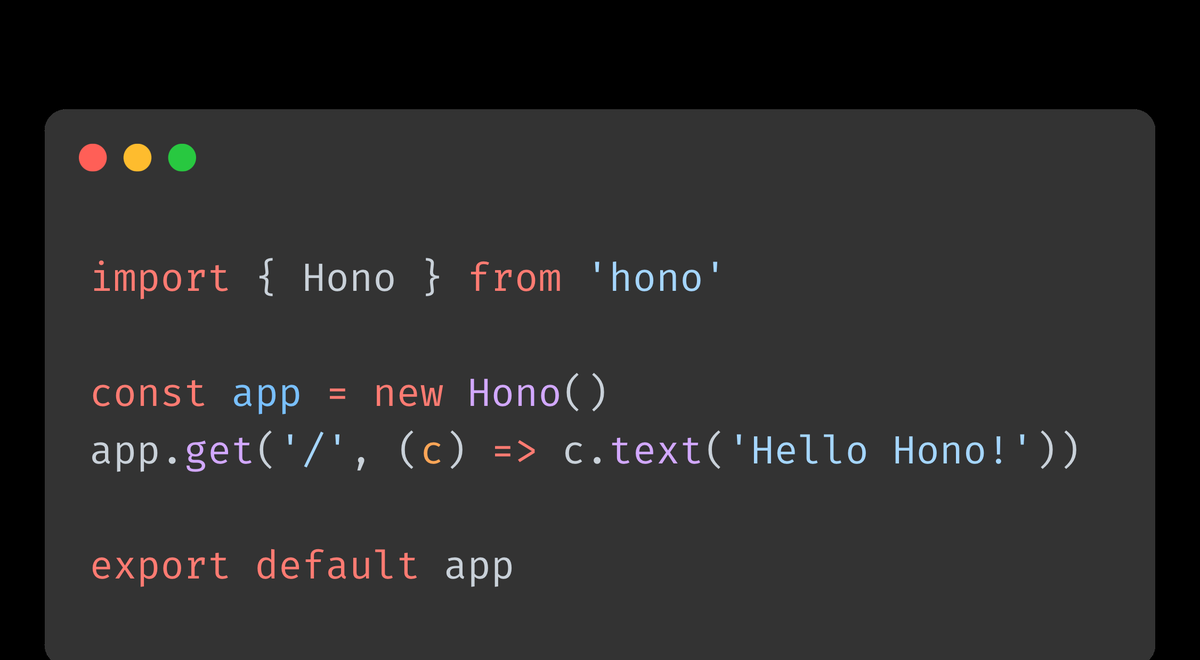
If you’ve ever watched a tiny API project spiral into a dependency forest, Hono will feel like a wake-up call. It’s a web framework built for modern runtimes—edge included—without the baggage. The headline is simple: Hono is ultralight, standards-based, and designed to run the same code across Cloudflare Workers, Deno Deploy, Bun, Vercel Edge, and Node.js. The result is faster iteration, cleaner middleware, and a TypeScript experience that doesn’t fight you.
Built on Web Standards (Not “Framework-isms”)⌗
Hono’s core philosophy is that the web already provides a great set of primitives. Instead of inventing a new request/response model or expecting you to learn a framework-specific abstraction, it leans on Web Standards. That matters because it keeps your mental model stable across environments.
In practice, this means you’re writing handlers that resemble how the web works: you accept requests, you return responses, and you use familiar HTTP concepts. When you deploy to an edge runtime, you’re not “porting” your application so much as moving it.
Concrete example: imagine you have a lightweight “health” endpoint and an API key gate.
import { Hono } from 'hono'

const app = new Hono()

app.get('/health', (c) => c.json({ ok: true }))

app.get('/secret', (c) => {
  const token = c.req.header('authorization')
  if (token !== `Bearer ${process.env.API_TOKEN}`) {
    return c.json({ error: 'unauthorized' }, 401)
  }
  return c.json({ data: 'classified' })
})

export default app
Notice the shape: concise routes, predictable request access, clean JSON responses. It’s the kind of code you don’t mind maintaining, even when the app grows.
The Real Superpower: One Codebase, Many Runtimes⌗
Most frameworks make you choose a runtime—then punish you when you try to move. Hono is the opposite. You can use the same framework code across multiple deployment targets, including edge platforms and standard Node.js.
That isn’t just a convenience feature; it changes how you build. You can prototype locally, validate behavior quickly, and then ship to an edge runtime without rewriting the app’s architecture.
Think about common teams and workflows:
- Edge-first products: you start at the edge to reduce latency and keep compute close to users.
- Prototyping: you build locally (or in CI) with the same framework you’ll deploy.
- Scaling needs: you may later split heavier work into separate services while keeping the HTTP edge surface lightweight.
Hono fits this reality because it doesn’t treat edge as a special snowflake.
Middleware That Doesn’t Feel Like a Mess⌗
Express-style middleware patterns are familiar, but they can become tangled—especially as you start composing cross-cutting concerns like auth, logging, CORS, rate limiting, and request shaping.
Hono’s middleware system is intentionally clean. The interfaces are straightforward, and the flow stays readable. Instead of scattering logic in ad hoc route handlers, you can assemble behavior at the app level and reuse it consistently.
A practical pattern is to define middleware for:
- Authentication (attach user context)
- Observability (log request IDs, timing)
- Input shaping (validate/normalize request bodies)
For example, you can create a middleware that ensures a request has a specific header before allowing access:
import { Hono } from 'hono'

const app = new Hono()

app.use('/api/*', async (c, next) => {
  const apiKey = c.req.header('x-api-key')
  if (!apiKey || apiKey !== process.env.API_KEY) {
    return c.json({ error: 'missing or invalid api key' }, 401)
  }
  await next()
})

app.get('/api/items', (c) => {
  return c.json([{ id: 1, name: 'Widget' }])
})
This is the kind of middleware you can reason about. It’s not hiding control flow in clever tricks; it’s explicit about “check, then next.”
Routing and TypeScript: Fast to Write, Hard to Break⌗
Hono’s routing is intuitive, and that matters more than people admit. If routing feels frictionless, you write endpoints more frequently—and that’s how teams end up with smaller, testable surfaces rather than one monolithic handler.
The TypeScript experience is also first-class. You get strong autocomplete, predictable handler signatures, and a codebase that stays friendly as it grows. TypeScript isn’t a bolt-on here; it’s part of the design.
Here’s a simple example of route-driven typing and safe response shaping:
import { Hono } from 'hono'

type Item = { id: number; name: string }

const app = new Hono()

app.get('/items/:id', async (c) => {
  const id = Number(c.req.param('id'))
  if (!Number.isFinite(id)) return c.json({ error: 'invalid id' }, 400)

  const item: Item = { id, name: 'Example Item' }
  return c.json(item)
})
The handler stays compact, but you’re still protected against sloppy assumptions. That’s how TypeScript should feel: helping without getting in your way.
Performance Without the Ego: Small Framework, Big Output⌗
Hono is built to be lightweight—around 12KB and with zero dependencies. That matters because dependency graphs create overhead: more installs, more build steps, more places for things to break, and more time debugging version mismatch issues.
The framework also targets performance realistically. It’s been benchmarked as faster than Express by an “embarrassing margin” in common scenarios. Even if you don’t obsess over microbenchmarks, the underlying point holds: fewer layers and fewer moving parts usually translate to better runtime efficiency and lower latency variance.
Where this shows up in the real world:
- Edge response times feel snappier because the request path stays lean.
- Cold starts are less painful because there’s less to load.
- Developer iteration speeds up because the framework doesn’t drag your build pipeline around.
If you’re building an API gateway, a webhook receiver, a set of CRUD endpoints, or any “lots of requests, little logic” service, Hono is a strong default choice.
When to Use Hono (and When Not To)⌗
Hono shines when you want modern HTTP behavior, clean composition, and runtime portability—especially for edge deployments and lightweight APIs.
Use it when:
- You’re deploying to edge runtimes and want to keep the code portable.
- You want a minimal server layer for an API or backend-for-frontend.
- You care about readable middleware composition and predictable TypeScript.
- You’re building services that should be easy to split, scale, and maintain.
Be cautious when:
- You need heavy, deeply specialized ecosystem features that you already depend on in a different framework.
- Your team is deeply invested in a specific middleware ecosystem and doesn’t want to migrate patterns.
- You’re building something that’s less “HTTP service” and more “full application framework” with lots of built-in conventions—because Hono’s strength is staying focused.
My opinionated take: if your service is fundamentally an HTTP API, Hono is the kind of framework you’ll be glad you chose early. Migration later is harder than it should be—so pick the lightweight, standards-based option now.
Conclusion: A Modern Default for Edge and APIs⌗
Hono is what Express would look like if it were designed in 2023 for today’s runtime reality: standards-based, edge-friendly, dependency-free, and genuinely pleasant to use in TypeScript. It’s small enough to stay out of your way, fast enough to matter, and consistent enough to deploy confidently across multiple platforms.
If you’re building APIs—especially edge-first ones—Hono deserves a spot in your toolkit.