Llama, Mistral, and the Open-Source LLM Revolution
For a long time, “building AI” meant negotiating access to proprietary models—paying API tolls, accepting platform rules, and hoping your prompts and data would never become collateral damage. Then something changed: open-source large language models stopped being a curiosity and started looking like infrastructure. Llama and Mistral didn’t just improve chatbots; they detonated the closed-AI business model’s gravity.
Meta’s detonation: when Llama broke the monopoly⌗
Meta didn’t set out to end the era of closed models. But when Llama 2 landed, it did the one thing proprietary vendors can’t: it gave developers a credible alternative that didn’t require permission slips.
The key shift wasn’t that Llama was “better.” It was that it was useable by ordinary teams. Once the model weights were available, developers could run them locally, fine-tune them, and integrate them into their own products without relying on an external API as the single point of failure.
That’s the real threat to vendor lock-in: when an alternative is technically viable, it becomes financially and operationally risky to keep depending on a single provider. API pricing changes. Rate limits appear. Terms of service evolve. Latency spikes. Suddenly, your AI roadmap is at the mercy of someone else’s billing dashboard.
Practical consequence: many teams stopped treating their LLM dependency as a product feature and started treating it as a pluggable component. You can see this mindset in architecture choices—routing requests through an internal service, adding fallback models, and tracking costs per feature rather than per experiment.
Mistral’s accelerant: smaller models, real capability⌗
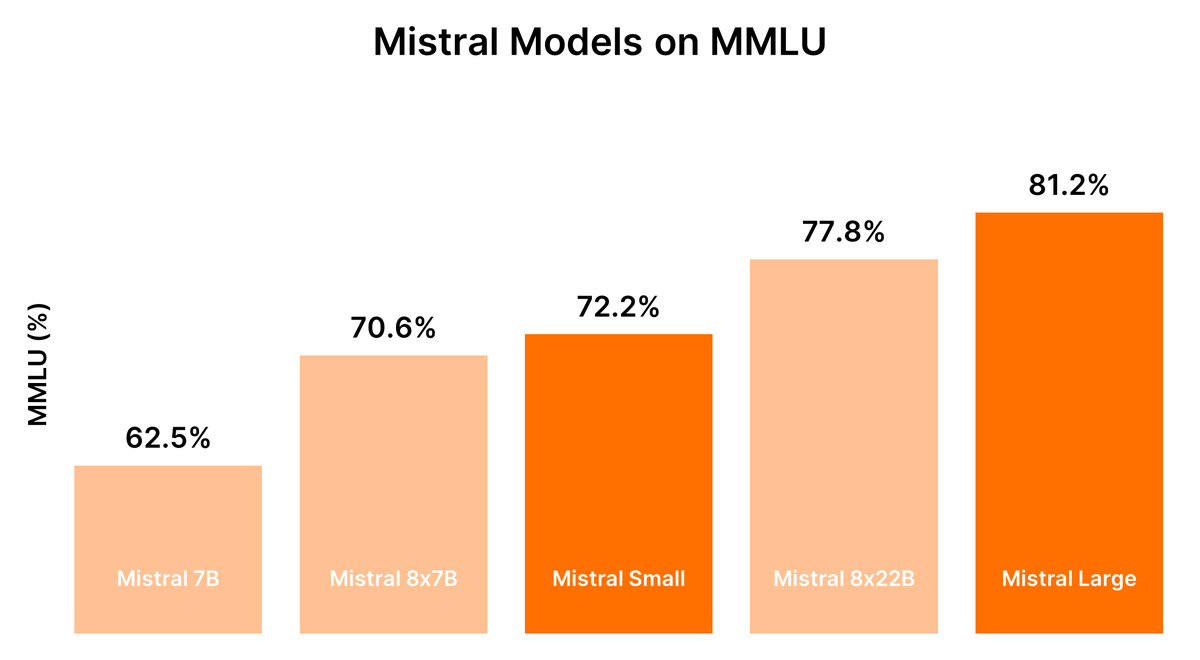
If Llama made the open-source case, Mistral made it scalable.
Mistral’s approach has consistently emphasized performance-per-parameter: models that can deliver high-quality results without demanding the kind of massive infrastructure reserved for frontier labs. In other words, open-source wasn’t just “possible”—it was increasingly “affordable.”
This matters because the economics of AI products aren’t dominated by the first demo. They’re dominated by iteration speed and steady-state inference cost. A smaller, capable model can mean:
- More frequent releases because you can experiment without waiting for budget approvals.
- More predictable latency for end users.
- Lower inference bills for production workloads.
- Easier deployment on your own hardware (or on cost-efficient providers).
Concrete example: imagine building a support assistant for an ecommerce site. With a compact model, you can deploy it closer to your app servers, reduce round-trip latency, and tune prompts for your ticket taxonomy. With a heavier model, you might still do that—but only if the cost profile allows it. Open models expand the range of feasible products.
The sharp truth is that “GPT-level” performance isn’t the only metric that matters. For many businesses, the winning move is good enough at the right cost, with control over deployment, data flow, and behavior.
The quantization boom: running smarter on consumer hardware⌗
Open-source also attracted a builder community, and builders hate waiting. As models became more common, the next bottleneck wasn’t training—it was inference.
That’s where quantization enters: techniques that reduce a model’s numeric precision (for example, storing weights with fewer bits) to shrink memory usage and speed up computation. Done well, quantization makes it realistic to run capable LLMs on consumer GPUs or even smaller setups—without turning your performance into a slideshow.
What this enables in practice:
- Local development workflows: Developers can test prompt strategies and tool integrations on their own machines rather than burning API calls.
- Privacy-sensitive deployments: If your data can’t leave your network, local inference becomes a non-negotiable requirement.
- Iterative fine-tuning and evaluation: You can run repeatable experiments faster when the loop doesn’t involve external services.
Quantization isn’t magic. You trade some quality or stability for efficiency depending on the method and target hardware. But the important shift is cultural: the community started treating model deployment as an engineering problem—not an exclusive privilege.
The moat was never the architecture—it was the supply chain⌗
It’s tempting to say open-source “wins” because models are getting better. But that’s not the real business lesson.
The moat for AI companies was never only model architecture. It was:
- Training data access at scale and with usable licensing,
- Compute to train and iterate quickly,
- Operational tooling to keep models reliable in production.
Architecture is comparatively easy to replicate once the community has the recipe. Compute and data are harder—and that’s why open-source threatens the old order so aggressively: it chips away at each layer of dependency.
When more organizations can host models themselves, the vendor’s “platform tax” becomes optional. When teams can evaluate multiple models side-by-side, a single provider’s advantage erodes. When developers can fine-tune for specific domains, generic model performance becomes less important than your ability to shape behavior and outputs.
Opinionated take: the closed-AI model benefited from asymmetry. Developers didn’t just buy inference—they bought uncertainty management: “Trust that the provider will handle it.” Open-source reduces that uncertainty by letting teams own the system end-to-end.
Building without lock-in: practical patterns that actually work⌗
The open-source shift doesn’t just change what model you use—it changes how you design your AI product. Here are practical patterns teams are adopting to avoid painting themselves into a corner:
1) Use an internal model gateway⌗
Instead of calling a vendor API directly from your app, route all LLM requests through an internal service. This gives you:
- centralized prompt/version management,
- consistent formatting,
- cost tracking,
- model switching and fallbacks.
If you start with open-source now, you can still migrate later—but you won’t have to rewrite your application to do it.
2) Separate “model logic” from “product logic”⌗
Treat the model as a component that transforms inputs to outputs. Keep your business rules outside the model: validation, policy enforcement, tool selection, and structured formatting. That makes behavior more predictable across different models.
A common winning approach is to push the model toward structured outputs (JSON schemas, constrained formats) and enforce them at the application layer.
3) Build retrieval and context like it’s a first-class feature⌗
Most real-world LLM systems aren’t “pure chat.” They’re retrieval-augmented generation (RAG), workflows, and constrained agents. Open-source models make it feasible to customize this entire stack—so the advantage shifts from “which model?” to “how well do you feed and verify the output?”
4) Plan evaluation like you plan security⌗
Don’t judge by a handful of examples. Create test suites that represent real user queries, failure modes, and regressions. Track:
- refusal behavior and safety,
- factuality and citation quality (when using retrieval),
- formatting compliance,
- latency and cost.
If you can’t evaluate reliably, model choice will feel like vibes.
Data privacy and cost: the unglamorous wins⌗
The revolution sounds glamorous, but the biggest benefits are boring—and that’s why they matter.
When you can run LLMs in your own environment, you can:
- keep sensitive text and documents within your infrastructure,
- control logging policies,
- reduce exposure to third-party retention rules,
- avoid surprising data handling changes.
And when you’re not paying per token to a vendor for every iteration, you can afford to improve the product instead of optimizing it down to the cheapest prompt that “kind of works.”
Example: a legal or HR workflow assistant often needs strict controls around document handling. With a closed API, every new integration risks a compliance review. With a self-hosted model (plus a well-designed retrieval layer), you can standardize the data path and keep approvals from reinventing themselves every quarter.
Conclusion: open models are becoming the default infrastructure⌗
Llama and Mistral didn’t just offer better chat. They shifted the balance of power by making LLM capability portable, testable, and deployable. The open-source ecosystem—quantization, tooling, fine-tuning practices—turned model ownership into a practical engineering option rather than a distant fantasy.
The closed-AI era didn’t end because proprietary models stopped being good. It ended because the dependency was no longer inevitable. Open-source is eroding the old moat, and it’s doing it in the most consequential way possible: by letting developers build AI features without asking permission every step of the way.