React Fatigue Is Real, and Svelte Knows It
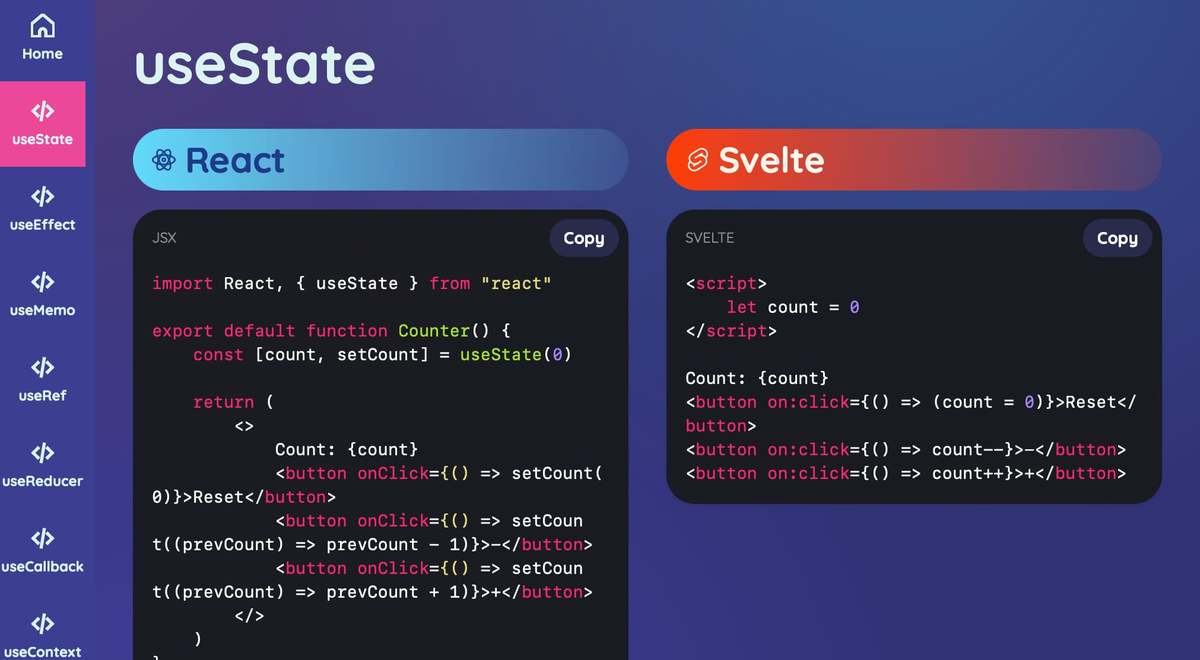
React didn’t just start a trend—it set expectations. For years, “modern front-end” meant thinking in components, mastering hooks, and treating state as the central character in every app. But somewhere along the way, the day-to-day experience started to feel like a treadmill. Not because React is bad, but because the surrounding ecosystem has become… loud. And in the loudness, developers are getting tired.
The framework wars aren’t over. They’re just evolving. React fatigue is real, and Svelte’s approach—compile away the framework at build time—hits a nerve: fewer abstractions, less ceremony, code that looks closer to what you actually ship.
The hook-era bargain—and the interest that keeps accruing⌗
Hooks were a breakthrough. They made function components first-class and unlocked patterns that class components made awkward. But the “hooks era” also introduced a kind of cognitive tax.
You don’t just write UI anymore. You also write rules for how state changes flow through time:
- Dependency arrays that must be correct or subtly wrong.
- Effect ordering questions that don’t always have intuitive answers.
- Stale closures that appear only under specific timing and render sequences.
- A steady stream of advice like “move logic into effects” or “avoid effects entirely,” often contradicting itself depending on who you ask.
In practice, this means more time spent reasoning about lifecycles than about interfaces. Consider a simple requirement: “When the user selects an item, fetch details and show a spinner, then render the result.” In React, you typically end up with effects, conditional logic, and careful dependency tracking:
useEffect(() => {
  if (!selectedId) return;

  let cancelled = false;
  setLoading(true);

  fetch(`/api/items/${selectedId}`)
    .then(r => r.json())
    .then(data => { if (!cancelled) setData(data); })
    .finally(() => { if (!cancelled) setLoading(false); });

  return () => { cancelled = true; };
}, [selectedId]);
It works, but it’s not inherently “UI code.” It’s choreography code—because the framework requires you to coordinate when and how side effects occur.
When developers say they’re fatigued, they’re often describing this feeling: the codebase is teaching you more about the framework than the product.
State management debates never end because the problem never quite resolves⌗
React’s flexibility is both its superpower and its curse. Almost any state can live anywhere: component state, context, reducers, stores like Redux/Zustand/MobX, server state libraries, caches, query layers, and so on. The ecosystem has solutions for everything—so the argument never fully shuts down.
You can see the pattern on real teams:
- “We need global state.”
- “Actually we just need derived state.”
- “Never mind, we need async caching.”
- “The app will be cleaner with a store.”
- “No, use context + hooks is simpler.”
- “We’ll regret that later.”
- “Let’s rewrite.”
React fatigue is often less about React itself and more about state architecture churn. Even when the team agrees on an approach, the boilerplate and mental overhead can pile up quickly: action types, selectors, memoization, cache invalidation strategies, and “why did this re-render?” investigations.
To be clear: state management is hard. Every framework faces it. But React’s model tends to encourage debates because it doesn’t prescribe a single, opinionated path for how UI state, server state, and side effects should be wired together.
Svelte’s pitch is different: less “pick a library for everything,” more “the compiler can do the bookkeeping.”
Meta-framework churn: when “React” turns into a stack you have to maintain⌗
Then there’s the meta-framework layer. In 2026, “React app” often means a particular combo of routing, rendering strategy, data fetching, bundling, styling conventions, and deployment assumptions. Next.js, Remix, custom SSR setups, edge runtimes, loading patterns, hydration quirks—the list keeps growing.
The result is a subtle fatigue: teams spend more time staying current with the platform layer than improving product code.
And the churn isn’t always optional. If you want the “right” conventions for SEO, caching, streaming, or routing, you inherit the framework’s worldview. That worldview then shapes your components, your fetching logic, and even how developers learn to think.
This is where many React developers start to crave simplicity—not in the sense of less capability, but in the sense of fewer decisions per feature.
Svelte’s radical move: compile away the framework⌗
Svelte’s central idea is disarming: instead of shipping a big runtime that interprets your components, Svelte compiles your code into efficient JavaScript at build time. The framework doesn’t have to “make things work” in the browser because it already transformed your intent into concrete instructions.
The practical effect is that you write less scaffolding and fewer coordination rituals. React asks you to tell it what state is and when to react. Svelte asks you to declare what UI depends on, and the compiler wires the updates.
Here’s a stylized comparison. In React, a component might juggle local state, effects, and conditional renders. In Svelte, the reactive dependency model is closer to how many developers naturally describe UI:
<script>
  export let selectedId = null;
  let data = null;
  let loading = false;

  $: if (selectedId) {
    loading = true;
    fetch(`/api/items/${selectedId}`)
      .then(r => r.json())
      .then(json => data = json)
      .finally(() => loading = false);
  }
</script>

{#if loading}
  <p>Loading…</p>
{:else if data}
  <h2>{data.title}</h2>
{/if}
This doesn’t mean you never need effects or async control. It means the “reactivity plumbing” is less verbose. And because Svelte tracks dependencies at compile time, updates can be more direct, without you constantly reasoning about render cycles and effect timing.
You still write real logic. You just spend less time translating your logic into framework-specific rituals.
Smaller surface area: why code feels closer to HTML/CSS/JS⌗
One reason Svelte feels like relief is that the code reads like a developer’s mental model of the browser: HTML for structure, CSS for presentation, JS for behavior.
Svelte components co-locate template and logic in a way that keeps your attention on the UI:
- Markup and state are right next to each other.
- Styling stays where it belongs, often in the same file without an extra ceremony layer.
- Event handling is straightforward and doesn’t require a new mental framework.
React is absolutely capable of this style—but the surrounding ecosystem often nudges you toward patterns that pull logic into separate files, wrap everything in abstractions, and turn “a component” into a mini-architecture project.
Svelte doesn’t prevent scaling. It simply gives you a smaller baseline. That matters when you’re building the second and third feature, not just the first.
Practical advice if you’re considering the switch: don’t treat Svelte as a “new framework to learn.” Treat it as a different default tradeoff. You’ll likely gain speed in everyday development, especially for UI-heavy apps where reactive updates are frequent.
But React isn’t dead—Svelte just proves you can optimize developer experience⌗
It’s tempting to declare framework winners like sports fans. That’s not how this plays out.
React is deeply entrenched. There are entire hiring pipelines, codebases, and libraries built around it. It’s not going away. And React teams can absolutely reduce fatigue—by enforcing architectural conventions, limiting the sprawl of state libraries, and choosing consistent patterns for side effects.
Still, Svelte’s existence changes the conversation. It proves that a UI framework doesn’t have to ship its own runtime burden to be powerful. It can compile your intent into something closer to hand-written JS. And that shifts the center of gravity back toward developer experience: fewer moving parts, fewer “gotchas,” and fewer places for the app to reinvent the same wheel.
The real evolution is this: React fatigue isn’t the end of React—it’s the beginning of a broader push toward simpler mental models.
Conclusion: the framework wars are evolving toward calm⌗
React fatigue is real because the ecosystem grew beyond the framework: hooks complexity, endless state debates, and meta-framework churn all add up. Svelte’s response is not a new dashboard of features—it’s a smaller system with a clearer job: compile components into efficient code and let reactivity be driven by dependencies, not rituals.
React will keep building the web for a long time. But Svelte’s win—developer love, not just benchmarks—signals something important: the next era of front-end isn’t about more abstraction. It’s about less ceremony, fewer decisions, and code that feels like it belongs to the browser, not to the framework.